buzzcart.uk
Sandalwood Gua Sha Massager – Nose, Eye & Pressure Point Tool
Sandalwood Gua Sha Massager – Nose, Eye & Pressure Point Tool
Couldn't load pickup availability
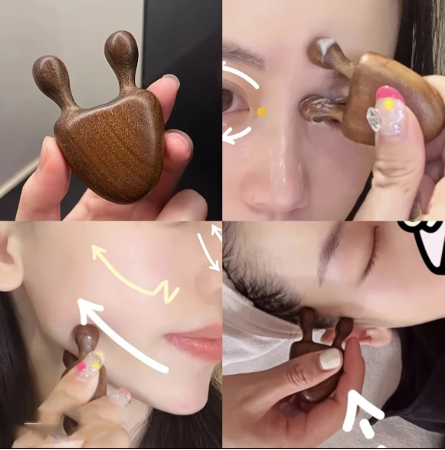
Most gua sha tools are flat slabs designed for the big sweeping planes of the cheek and jaw. They're useless on the fiddly bits — the bridge of the nose, the inner corner of the eye, the ridge of the brow — which is where a lot of tension and congestion actually sits.
This one is carved to a curled shape specifically for those areas. It's small, it's silent, and it'll still be working in ten years.
Where it earns its place
- Bridge and sides of the nose — where glasses sit and congestion gathers
- Inner corner of the eye — that specific ache after a screen day
- Along the brow bone — for the tension you get from frowning at a monitor
- Temples and hairline — where a tension headache starts
How to use it
- Apply facial oil first. This matters — wood on dry skin drags and can leave marks
- Hold it almost flat to the skin, not at an angle
- Short, slow strokes, always away from the centre of your face and upwards
- Three to five passes per area. Two minutes total is a full session
Wood versus stone
Worth knowing before you choose. Sandalwood is warmer, lighter and quieter in the hand than jade or rose quartz — and it will not go cold in the fridge, because wood doesn't hold temperature. If the cooling sensation is what you want, buy a stone tool or an ice roller instead. If you want something comfortable that works into small areas, this is better.
Looking after it
Wipe it with a dry cloth after use. Don't soak it, don't put it in water, and don't leave it somewhere damp — it's natural wood and it will eventually crack. It has a faint sandalwood scent that fades over the first few weeks.
Questions we get asked
Can I use it on my body? It's too small to be efficient on large areas, but it's very good on the hands and the base of the skull.
Will it help my jawline? A flat gua sha or the dual-head roller is better for jaw sculpting. This is a precision tool.
Can I use it over active spots? No — work around them.
Share